Size
Your email has been successfully removed.
Click & Collect
My Cart
Subtotal:
Delivery:
Product(s) added to Favorites
Product (s) removed from wishlist
Item(s) added to cart
My CartAdded to comparator
Removed from comparator
Where should we send your order?

To start the search enter at least 3 characters of a description, brand or reference number
Word searched
Size
Your email has been successfully removed.
Size
Your email has been successfully removed.

Filter and Sort
Size
Your email has been successfully removed.
Size
Your email has been successfully removed.
Size
Your email has been successfully removed.
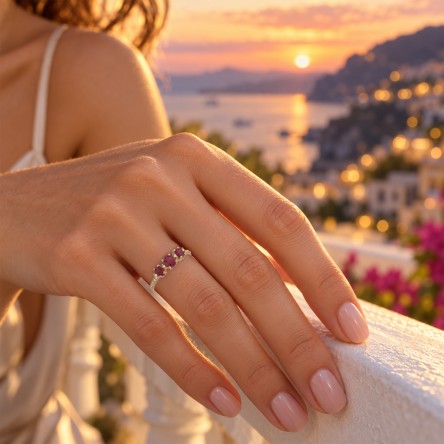
At BlueBird, ruby engagement rings are more than just jewelry - they are a symbol of passion and commitment. With sophisticated design and the vibrant red of the ruby, each piece is a unique representation of deep and lasting love.
| Use to view more |
|---|
What is ruby: red corundum with exceptional hardness
Ruby is the red variety of the mineral corundum (the same mineral as sapphire), with its color resulting from the presence of chromium. It has a hardness of 9 on the Mohs scale — making it one of the hardest gemstones, second only to diamond.
Technically, ruby and sapphire are the same mineral — corundum — distinguished only by their color: red corundum is called ruby, while all other colors are called sapphire. Ruby's red color is due to the presence of chromium in its crystal structure, and the more intense and pure the red, the more valuable the gemstone. The most sought-after shade, a vivid, deep red with a slight hint of blue, is traditionally known as "pigeon blood" red. With a hardness of 9, ruby shares sapphire's advantage of being highly resistant to scratches and everyday wear, making it one of the few colored gemstones truly recommended for an engagement ring intended for daily use. Interestingly, high-quality rubies of significant size are among the most valuable gemstones in the world per carat — exceptional rubies can command higher prices than comparable diamonds due to their rarity. Like sapphire, most rubies undergo heat treatment to enhance their color, a standard and accepted practice.
Why choose a ruby for an engagement ring
Ruby combines three qualities that make it ideal for an engagement ring: exceptional durability for everyday wear, a dramatic and unique red color, and the most powerful symbolism of passion and love among all gemstones.
Ruby is the choice for those who want their engagement ring to make a bold statement. The first advantage is practical: with a hardness of 9, ruby withstands everyday wear just as well as sapphire, far better than softer gemstones such as emerald. The second is aesthetic: ruby's red color is the one most strongly associated with love and passion, and it has an immediate, dramatic visual presence that no other gemstone can match. The third is symbolic: throughout history, ruby has been associated with passion, burning love, vitality, courage, and power — it was revered as a gemstone of royalty and protection in various cultures, and its intense red color has always been linked to the heart and blood, and therefore to life itself. For an engagement ring, ruby conveys an intense, passionate, and powerful love — a striking alternative to the serenity of diamond or the tranquil blue of sapphire.
Ruby and diamonds: the dramatic combination
The most common combination in ruby engagement rings is a central ruby accompanied by diamonds, whose colorless brilliance intensifies and enhances the red of the main gemstone.
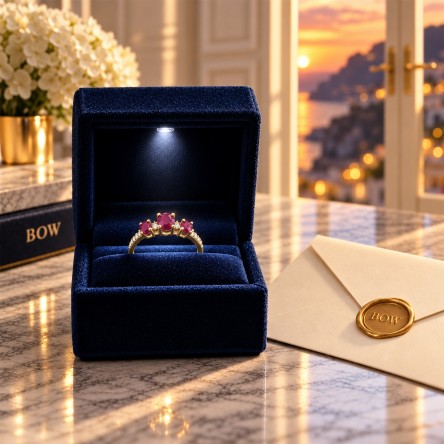
The contrast between the fiery red of ruby and the crystalline brilliance of diamonds is one of the most striking combinations in jewelry. Diamonds can surround the ruby in a halo setting (dramatically intensifying the red and enhancing its visual presence), accompany it as side stones in a three-stone setting, or be set along the ring's band. Most ruby engagement rings at BlueBird, from the brand Bow Gold and Diamonds, feature this combination of ruby and diamonds in 18K gold. Yellow gold creates a warm, luxurious contrast with the red, while white gold produces a more modern effect in which the red takes center stage.
Symbolism and history of ruby
Ruby is known as the "king of gemstones" and symbolizes passion, passionate love, vitality, and courage — it is the gemstone most intensely associated with love.
Few gemstones carry such powerful symbolism so directly connected to love as ruby. Throughout history, its deep red color has been associated with the heart, blood, passion, and life. In Sanskrit, ruby was called "ratnaraj", meaning "king of gemstones". Various cultures attributed powers of protection, vitality, and courage to it, and royalty wore it as a symbol of power and status. In the context of an engagement, this symbolism makes ruby a particularly expressive choice: while diamond symbolizes permanence and sapphire represents fidelity, ruby symbolizes passion and the intensity of love — making it the preferred gemstone for those who want their ring to convey the strength and ardor of the emotion it celebrates.
How to choose a ruby ring and payment options
The choice depends on the intensity of the red color, the type of setting (halo, three-stone, solitaire), and the gold color. The purchase can be made online or in-store, with installment payment options available.
When it comes to rubies, color is the most determining factor in their value — the ideal red is vivid, intense, and pure, neither too dark nor with brownish tones. As for the setting, a halo maximizes visual impact and makes the ruby appear larger, a three-stone setting adds symbolism, and a solitaire offers refined, bold elegance. Regarding the gold color, yellow 18K gold creates a warm, classic contrast with the red, while white gold allows the red to take center stage with a more contemporary effect. For those undecided between colored gemstones, there are also sapphire rings (blue, equally durable) and emerald rings (green). Purchases can be made at any of the 14 BlueBird stores (recommended for viewing the color in natural light and adjusting the ring size) or online with Express Click & Collect in 2 hours, with installment payment options available for higher-value purchases. For cleaning or checking the setting, technical assistance is available at physical stores.
Frequently Asked Questions (FAQs)
Yes. With a hardness of 9 on the Mohs scale, ruby is one of the hardest gemstones, second only to diamond, alongside sapphire, and is one of the most recommended colored gemstones for rings intended for everyday wear.
A hardness of 9 means that ruby is highly resistant to everyday scratches — only diamond and moissanite can scratch it. Like sapphire (they are the same mineral), ruby is much more suitable for an engagement ring worn daily than softer gemstones such as emerald. With basic care — regular cleaning and avoiding very strong direct impacts — a ruby ring can remain in excellent condition for decades.
They are the same mineral (corundum). Red corundum is called ruby; all other colors of corundum are called sapphire.
The distinction is purely based on color. Red corundum, due to the presence of chromium, is classified as ruby. Any other color of corundum — blue, pink, yellow, green — is classified as sapphire. In terms of hardness, durability, and care, ruby and sapphire behave exactly the same way because they are the same mineral. The boundary between a "ruby" and a "pink sapphire" is sometimes a subject of gemological debate and depends on the intensity of the red color.
High-quality rubies are extremely rare — exceptional rubies with "pigeon blood" red color are among the most valuable gemstones in the world per carat and can exceed the value of diamonds.
Although affordable rubies exist, rubies with intense color, high clarity, and significant size are among the rarest gemstones — rarer than comparable diamonds. A natural, untreated ruby with "pigeon blood" red color and a substantial size can achieve extraordinary prices at auction. For a typical engagement ring, however, there are beautifully colored rubies available at accessible prices, especially when combined with diamonds in 18K gold. Color is the main factor determining price — the more vivid and pure the red, the more valuable the ruby.
Yes. Most rubies undergo heat treatment to improve their color — it is a standard and accepted practice. Untreated rubies are rarer and more valuable.
Like sapphire, ruby frequently undergoes heat treatment (controlled heating) to intensify and even out its red color. This is a completely accepted practice in the gemological industry, used for centuries, and it does not compromise the gemstone's durability. The vast majority of rubies on the market are heat-treated. Rubies certified as "unheated" are rarer and command higher prices, but for most engagement rings, heat-treated ruby offers excellent value for money.
Ruby pairs particularly well with yellow gold (a warm, classic contrast) and white gold (a contemporary effect that allows the red to stand out).
Yellow gold and ruby form a classic, warm, and luxurious combination, in which the gold and red tones complement each other in a rich, traditional style. White gold offers a more modern and neutral contrast, allowing the red to take center stage. Rose gold can create an interesting and contemporary tone-on-tone combination, although it is less common. The choice should take into account the bride's personal style and the other jewelry she wears.
Ruby is the birthstone for July, adding a personal touch for brides born in that month.
As July's birthstone, ruby has an additional meaning for brides born during this month — the ring becomes both a symbol of commitment and a celebration of their birth month. BlueBird offers a dedicated collection of birthstones from the Bow brand.
| Use to view more |
|---|